In February 2025, CPKC officially announced the opening of a second span of their Patrick J. Ottensmeyer International Railway Bridge, which crosses the Rio Grande between the U.S. and Mexico at Laredo, TX. This work is reported to have doubled the capacity to move rail freight at this location, on a structure named in honor of the late KCS President and CEO. This $100 million project, begun in 2022, will clearly be an improvement to CPKC’s capacity to serve shippers and the North American economy for decades to come.
The capacity of a railroad, or portion thereof, is a subjective matter and is based on a number of components. While some may argue that determining the capacity of a line is a science, my experience has been that it is indeed much more of an art. When railroaders determine the specific capacity of a line, key indicators such as speed, consistency, and train length capabilities are typical of the factors in play.
Speed is critical to increased capacity. The faster the track, the more trains that can be operated over the specific line of railway. On key main routes, increased speed through sidings, reducing curvature and bottlenecks in order to remove permanent slow orders, and the continued improvement of track infrastructure all help boost capacity. On short lines and feeder lines, where train volumes per day compared to main line railroading are lower, speed becomes less of a factor. However, short lines are also capable of adding capacity with their own specific projects, also important to the delivery of first and last mile carloads.
Consistency is another goal that capacity planners work to achieve. The fewer times trains are forced to stop over the road contributes to operational fluidity and reduces the risk of delays. Once again, out on the high iron, having bypass routes around areas where trains generally stage or perform switching, fuel, change crews, or conduct inspections reduces planned or unplanned stops that consume capacity. The progression over the last two decades toward longer trains also increases capacity. In short, the more cars that can be placed on a train generally results in fewer actual trains that need to be operated to move a set amount of goods.
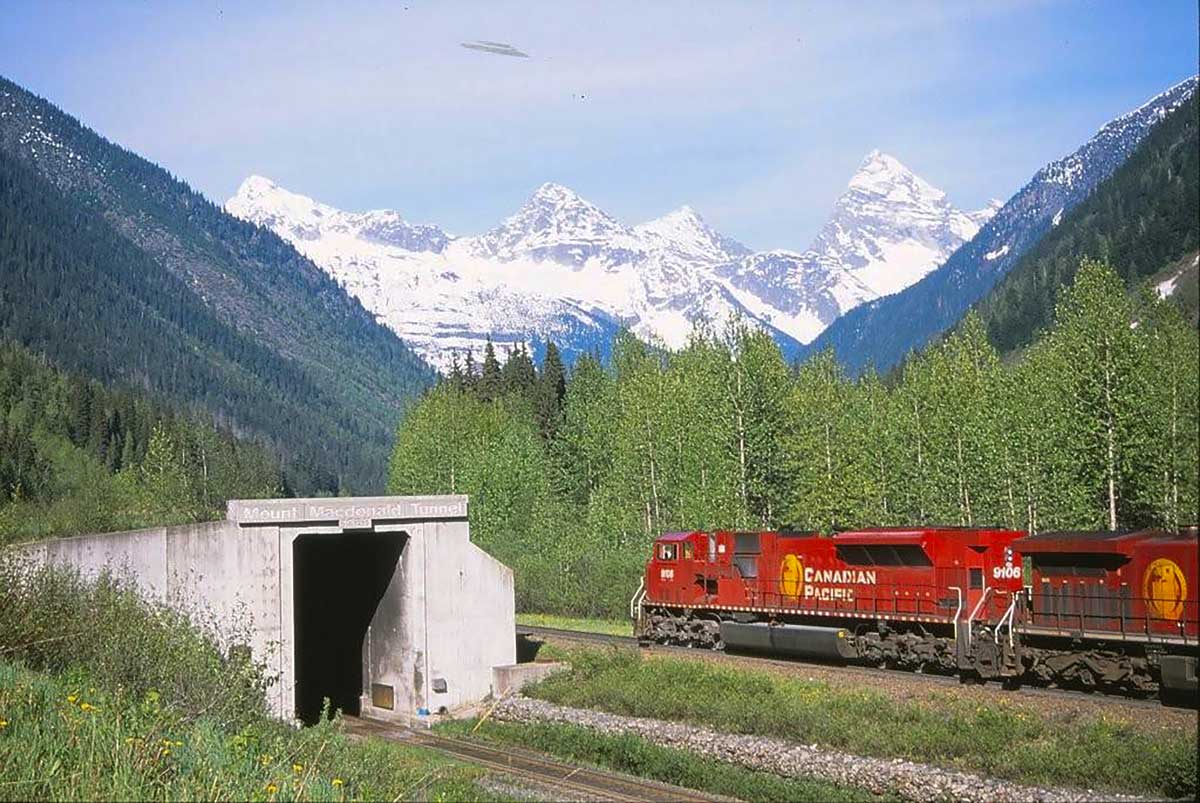
A master engineering achievement—CPKC’s Mount Macdonald Tunnel, while an eastbound train passes on the Connaught Tunnel line.
Without question, the relatively modern investment in capacity along Western railroads has provided significant financial benefits to the bottom line of shippers and railroads both large and small, and thereby the overall economy. Creating new capacity to move growing volumes of grain, fertilizer, potash, and energy products to natural markets was a challenge that rails like CPKC, CN, and BNSF, in particular, all took up at various points in recent history. At the same time, once-important transcontinental express and passenger routes evolved into critical intermodal lanes. It’s been a fascinating evolution of the rail network map: going from single track routes—some not far removed from their construction days—to modern high-capacity lines that feature significant mileages of new second-main track, along with upgraded infrastructure, sidings, and signals. Ultimately, these investments have ensured safe operation for heavier bulk trains and a growing list of energy shipments, and have provided the required additional meet and pass locations for operations often exceeding 10,000 feet per train.
Capacity projects on a railway can be described as “legacy” investments. Notable examples of 1980s capacity projects that continue to provide benefits for today’s supply chain include the upgrading of CN’s main track west of Edmonton, which in very recent times has also seen new additional investments, and CPKC’s (then CP’s) Rogers Pass Project of the same era that featured a new 9.1-mile tunnel through the heart of the Selkirk Mountains, together with several viaducts. These were without question mega-projects, with the CN project featuring additional upgrades such as concrete ties to support new bulk traffic for export markets, and the CP project knocking out permanent slow orders that had been a drain on capacity for decades.
CN Mountain Region Chief Engineer R.M. (Ron) Bailey (left) and Roadmaster Peter Swiderski, at Ardrossan, Alberta, c1982. (R.M. Bailey collection)
CN concrete tie program in action deep in the Rockies at Lempriere, British Columbia, 1976 (R.M. Bailey collection)
From a people perspective, I can think of some of the brightest railroaders in the business who have been involved in both planning and executing network capacity over the years. Good friend and now retired Director of Interline Planning at CP, Wayne Carten, was a professional engineer who worked closely with the entire team at Revelstoke during the construction of the Rogers Pass project. Likewise, long-time colleague Bill Salmond has been responsible for planning much of the capacity work that would eventually help transform the CP into a more efficient operation, capable of handling growing demand. Both Bill and Wayne still serve Northern Plains as consultants, and the knowledge gained during their careers continues to be invaluable to the industry at large. A look at the CN legacy harkens back to the leadership of Mountain Region Chief Engineer R.M. Bailey, P.Eng., who, along with Ross Walker, Vice President of the day, led the transformation of the CN main line west of Edmonton. Improvements made on both the former Canadian Northern line to Vancouver and the B.C. North Line to Prince Rupert have enabled continued growth of export volume, and now intermodal services which have grown rapidly. Today, in the department responsible for network capacity planning, Ron’s grandson, Doug Bailey, continues the family legacy, together with experienced railroaders like Sean Robitaille. Each day, their important work helps CN look toward the future.
In addition to being informed and supportive of the capacity projects that individual railroads sponsor, plan, and execute—including many that have been championed by the short line industry—we need more than ever to let our elected representatives know about the value of rail capacity investment, as it is often a shared challenge. To be successful in expanding network capacity, stakeholders who benefit must come together in advocacy and planning, and at times, share in the funding requirements. As we look to the future, continuing to build on the legacy of rail network capacity improvements over the past half-century is not only good business, but vital to our continued economic success.